
Why Your Neck Hurts (And Where It Actually Starts)
Here's something we see every single day in the studio: the place that hurts is almost never where the story starts.
Your neck is the last stop on a long chain reaction — one that usually begins somewhere around your hips, runs through your ribcage, and ends up as that persistent ache at the base of your skull.
The good news? If you can find where it starts, you can actually fix it.
It Starts With How You Breathe
Before we talk about your neck, we need to talk about something even more fundamental — your breath.
When life gets busy, stressful, or sedentary, most of us stop breathing the way we're designed to. Instead of a deep belly breath that expands the ribcage fully, we default to shallow chest breathing — short, tight, relying on the emergency muscles in the neck and upper chest to do the work.
Here's what that does over time: it keeps your ribcage in a perpetually collapsed position. And a collapsed ribcage doesn't just affect your breathing — it changes the position of everything above it. Your neck. Your jaw. The base of your skull.
When the serratus anterior is weak, the ribcage collapses. When the ribcage collapses, the neck and jaw follow. Shallow breathing and ribcage position are part of the same loop. One feeds the other.
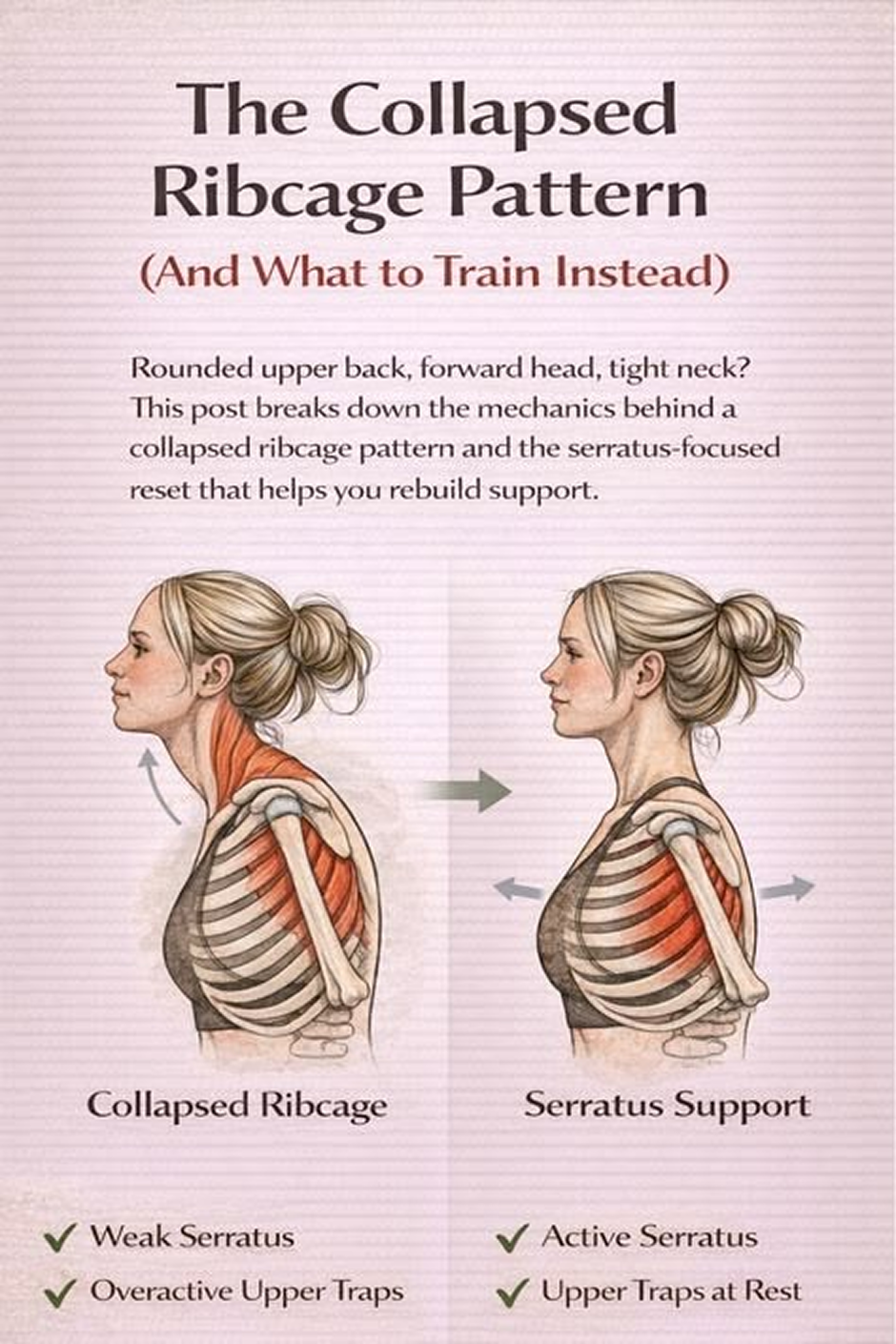
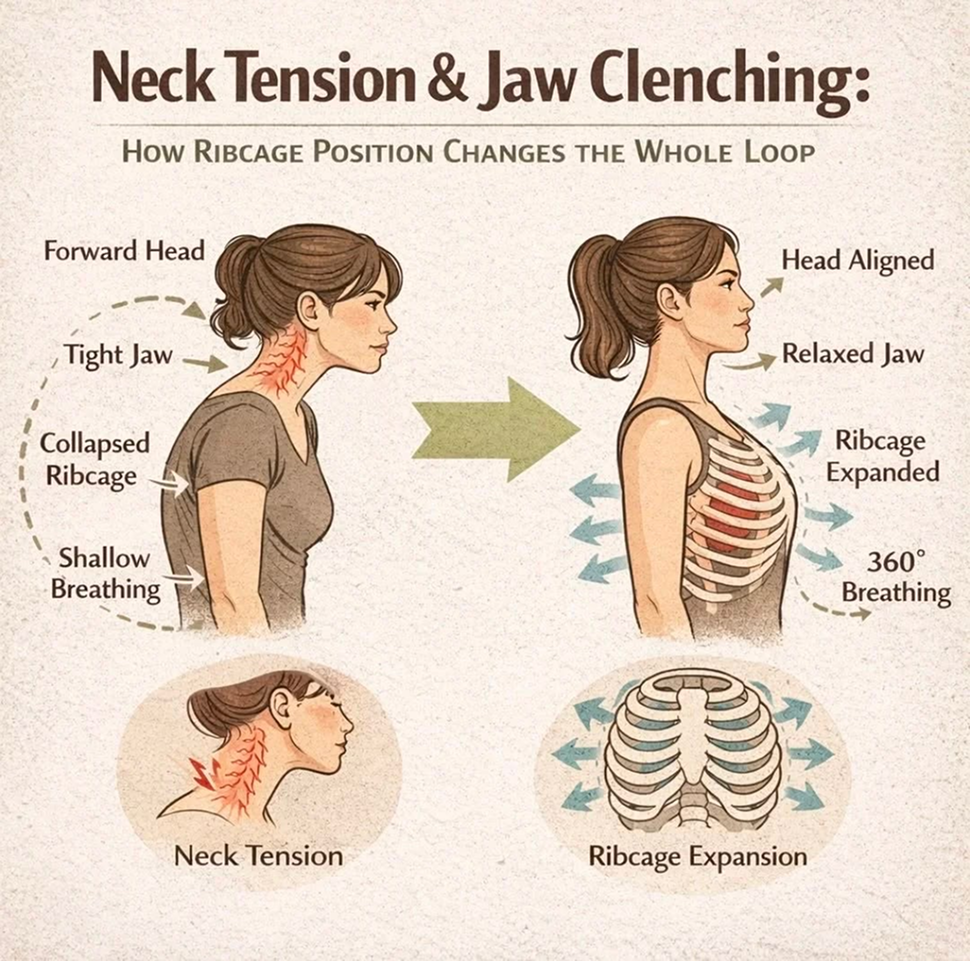
The good news is that breath is also where the reset begins. When we learn to breathe deeply and fully — expanding the belly, the sides, the back of the ribcage — we start to restore the foundation that everything else is built on.
Learn more about how jaw placement and breath work together.
The Chain
If you've taken class at Shed, you've heard me talk about the chain. This is what I mean.
Your body isn't a collection of isolated parts. It's a continuous system of muscles, fascia, and connective tissue that runs from the bottom of your feet to the top of your head. When one part of that system gets tight, weak, or out of position, the parts above and below it have to compensate. Over time those compensations become patterns. And those patterns are what show up as pain.
There are two lines that are particularly important for understanding posture and neck pain.
Superficial Back Line
The superficial back line runs from the bottom of your foot up the back of your body to your forehead. When this line is weak or overstretched, it stops being able to hold you upright.
The superficial front line runs from the top of your foot up through the front of your body to your skull. When this line gets tight — think hip flexors, chest, neck — it pulls everything forward.
Superficial Front Line
What Happens to Your Head
Now that you understand the chain, here's where it ends up — and why it matters so much.
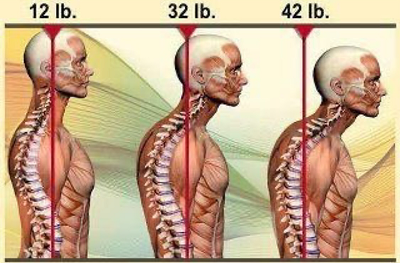
Your head weighs about 12 pounds. Roughly the weight of a bowling ball. Perfectly manageable when it's balanced directly over your spine.
But for every inch your head drifts forward — pulled there by a tight front line, a collapsed ribcage, a pelvis that tipped forward hours ago — the effective load your neck has to carry doubles. A few inches forward, which is most of us by midday, and your neck is working against the equivalent of 42 pounds.
This is why your neck is tired. It's been doing heavy lifting all day.
And here's something you might not have noticed: as your posture shifts, so does your center of gravity. Instead of being distributed evenly through your foot, your weight starts creeping toward your toes. Your body is leaning forward and working overtime just to keep you upright. The further that lean goes, the heavier everything above it becomes.
Notice the center of gravity shift toward the toes. One degree of lean changes the load on everything above it.
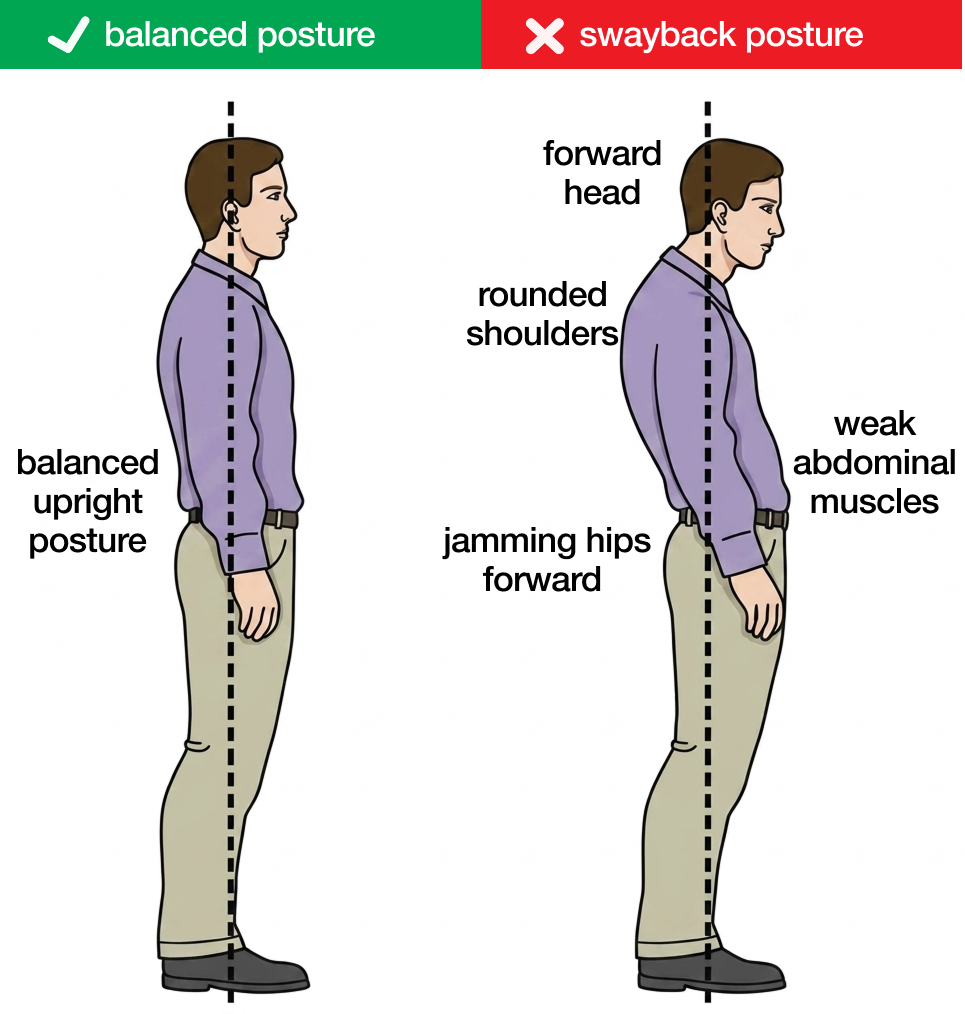
That tension at the base of your skull, the ache across your upper back, the tightness that never quite goes away — it's not a neck problem. It's a posture problem that ends at your neck.
It’s all connected! Here’s an anatomical look at the two postures compared to each other and how it impacts the body.
Why It Gets Sticky
Here's a question we get a lot: if I know my posture is off, why is it so hard to just fix it? The answer is fascia.
Fascia is a layer of connective tissue that runs throughout your entire body — below the skin, around every muscle, organ, and bone. It's what gives the chain its continuity. And it has a tendency to get tight and sticky, especially when we hold the same positions day after day.
“Think of a ball of pizza dough. It starts out as a small, tight ball. But through kneading, pressing, and stretching, it becomes a malleable dough that can be shaped into something new. Fascia works the same way. Without regular movement and release, it molds itself to whatever position you're in most — and holds you there.”
What Releasing It Looks Like
The good news is that fascia is malleable! It responds to pressure, movement, and consistency. Myofascial release — a type of targeted massage — is one of the most effective ways to begin unwinding the patterns that have built up over time.
All you need to get started is a tennis ball and a wall.
But before we go further, there are two things that are crucial any time you work on any part of your body — and this includes your pelvic floor
Release first. Strengthen after.
Here's why that order matters. When we release, we're creating space — unwinding the fascia that has wrapped itself around your muscles and tendons and held them in a compromised position. But releasing alone isn't enough. If you strengthen before you release, you're just building more tension on top of a pattern that hasn't changed. And if you release without strengthening, the body has nothing to hold the new position with.
Release to realign. Strengthen to hold it.
I have a 10-minute video that walks through the complete release and strengthen sequence for your neck, head position, and upper back — so you can start applying this work on your own, between classes.